


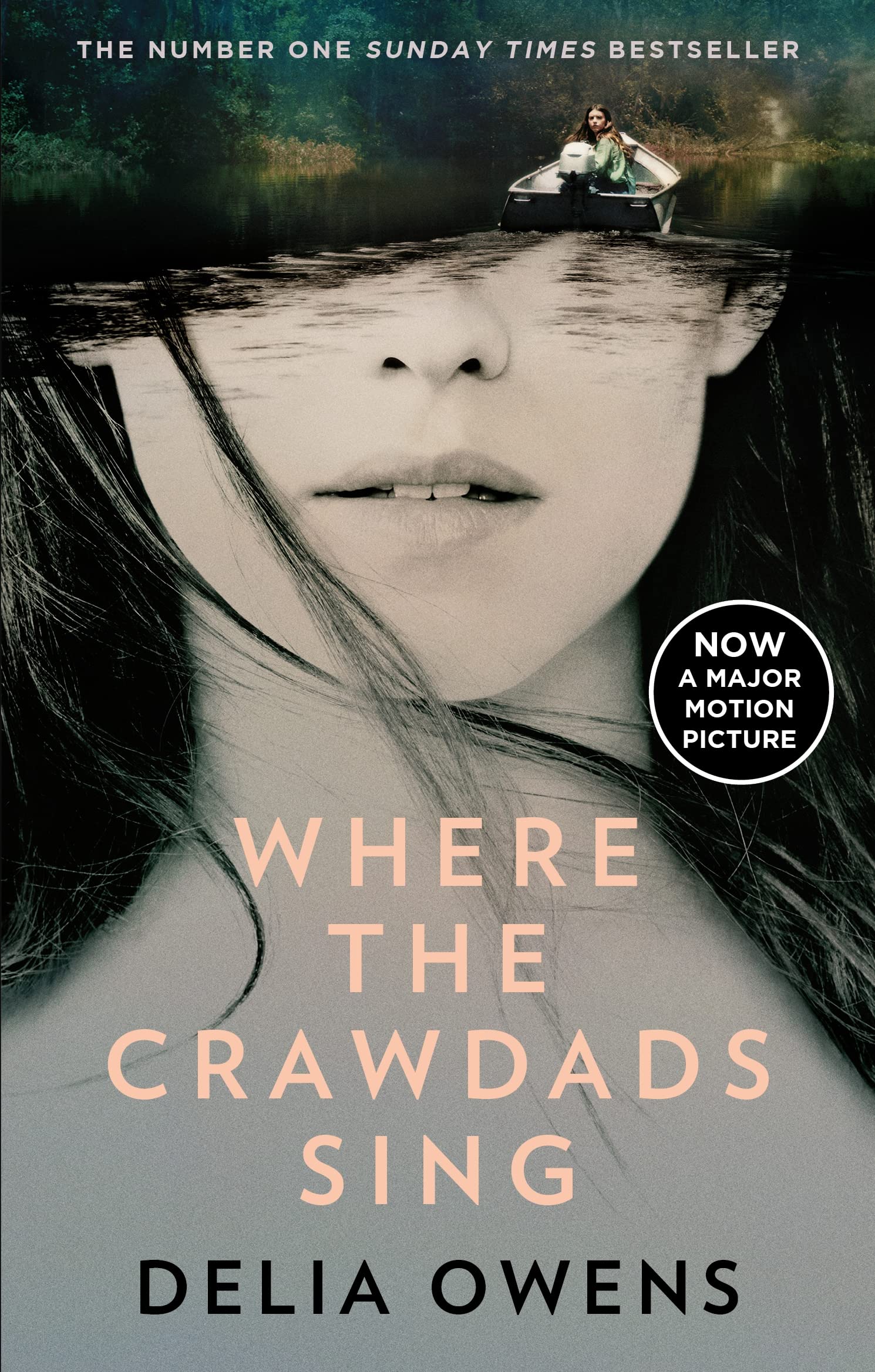
Where the Crawdads Sing
ISBN : 9781472157362
Author : Delia Owens
(0 Reviews)
Out of Stock
Estimate Shipping Time:
Sold By:
Inhouse product
Inhouse product
Price:
EGP445.000
Share:
Vista Ecommerce
(0 customer reviews)
Top Selling Products
-

As Long As the Lemon Trees Grow
EGP385.000 -
Pinocchio (Campbell First Stories)
EGP290.000 -
The Ritual
EGP480.000 -
Before the Coffee Gets Cold
EGP480.000 -
The Psalm Killer
EGP480.000 -
هوامش المقريزي حكايات من مصر
EGP180.000



I just finished reading (and crying through) the first novel by naturalist Delia Owens entitled, “Where the Crawdads Sing”. She has achieved a literary feat uncommon to naturalists, let alone novelists. 67 weeks at the top? Her readers are not wrong. But first, let’s talk about crawdads…Do they sing? No. They are tiny freshwater lobsters that live underwater. They only sing, as do Maine, and rock lobsters, when you put them in a pot of boiling water and the steam expands through their exoskeleton. So no, they do not sing, nor do they do anything else that can remotely be depicted as human. However, the phrase, “Where the crawdads, sing”, is fully defined by Owens thus cannot be confused in her novel The reference to their presumed music as defined by Owens is one of her many uses of a colloquialism. She spells it out using the complete phrase, “ Way out yonder where the crawdads sing”. More context for the less colloquial is that the full phrase means in the middle of nowhere. Which is exactly where the story takes place. In the middle of nowhere. It takes place in a marsh (not a swamp, there's a difference) along some stretch of coast on the eastern seaboard of the United States. The exact location doesn’t exist. It’s fictional. Owens includes a map, which I referenced frequently. Mind you, this is no Narnia, this is no Middle Earth, but this is as real a place, even more real, than any presumed backdrop for any other great novel. West Egg for instance. Just like West Egg on the north shore of Long Island, this marsh on the eastern shore of North Carolina cannot be found on any map, nevertheless, it’s a place I would like to visit.The phrase, thus, refers to being beyond the most remote area of the wild as possible. Off the map, off the grid. Way out yonder where the crawdads sing. A place, very different from, and as remote as, any place in Africa where Owens spent much of her professional life as a naturalist. Beyond anything we know, the marsh she created is truly in the middle of nowhere. It is here where the main character, Kya, finds herself alone. She has been left alone by family and most of humanity. We are witness to the abandonment. As a little girl she is forced to live on her own and survive in the wild. Shades of Jody Foster from the movie Nell…except she speaks English and she has a lot more food to eat. That is, if you like seafood. Mussels and smoked fish, and whatever sprouts from a shabby wild vegetable garden. She was not raised by wolves, or gorillas, but instead by the marsh itself. And a lot of seagulls and other sea birds. The marsh is her mother. Most of us couldn’t fathom the life of Kya--essentially on her own since age seven. Think about that for a moment…if you don’t cry…you should. I cried three times in the first 125 pages of the story. I cried 4 or 5 more times before the end of the story.This book, I presume since Owens is well read having spent a lot of time on her own, crosses many genres. Her naturalist side shines through as the wild is on display on every page. Yet her story is a murder mystery since the body of Chase Andrews is found dead in the marsh in the prologue. She uses poetry frequently. Her own poetry, which is quite good. And of course, it is a love story of deep dimension. Difficult--to say the least--because finding love in the middle of nowhere is not easy. Unless you find it within yourself. One can’t say it’s a coming of age story, since the novel spans all of Kya’s lifetime…but yes…a Marsh Girl can come of age…and have it all. And of course there is the courtroom scene related to the murder. Pick an author, Grisham, perhaps. We shall see when Hollywood releases their version in a few months how Owens dialogue holds up to Perry Mason. Will the courtroom dialogue be credible? Despite Kya’s profound literacy, which you will discover on her journey, Kya doesn’t pull a Lisbeth Salander (Stieg Larsson) and turn the tables on the court. She’s more humble, crippled outside her marsh, withdrawn from the process, meditating, and mostly concerned with the cat who lives in the court house. If you are rooting for her, as I was, prepare for another bout of tears.The book is a page turner because this story jumps from the pages and comes alive in your mind. Kya is real. She is alive. She will now exist in literature just as Captain Ahab and his whale. Kya and her Marsh. Owens brought her to life through her thoughts, her paintings, her poetry, and her music. Perhaps the best apologetic for an absent family, Owens walks through the conditions that must have been present for those responsible for her abandonment to receive forgiveness. As well as those who cared, but not enough, to keep her isolated. The reckoning, in the courtroom, was perhaps insufficient. Justice could never be served for the rising fear and prejudice visited upon this young girl by a town full of ignorant people. Yet some did rise above, in their own way, and Kya understood. It’s her understanding of human nature, through the eyes of our own evolution that shows us that we are not too far removed from the animal kingdom. There but for the grace of God…not into the fires of hell but rather into the bountiful Garden of Eden--the Marsh. The sins of the animal kingdom cannot be judged as sins--as when an injured mother fox leaves her kits in order to survive to another day where perhaps she may rear another litter when survival is more certain. Can the momma fox be judged?This is perhaps Owen’s legacy. Crawdads don’t sing--a fiction at best and anthropomorphism at worst. She knows it. Animals do not take on human characteristics. Only the truly ignorant would believe things move in that direction. Fake naturalists such as Elizabeth Marshall Thomas (The Hidden Life of Dogs) springs to mind as the purveyor of such garbage. Rather we can now look to Owens as the author of something as profound and insightful as from the true greats like Henry David Thoreau who wrote, "In wildness is the preservation of the world”. Here is where Owens lives. Here is where Owens sings. Her voice a whisper above the din but a true voice calling out in the wilderness to be heard above the wind through the palmetto trees or the waves crashing on the sand leading into the marsh. To the gulls who circle above the beach and are friends with Kya as she sleeps. To the other wildlife that saunter by her without pause. She is one of them, not the other way around. Justice, therefore, is a natural one and subscribes to nature’s law. Balance in this natural world can always be restored. This is the true beauty of Owens' novel and no doubt the key to her success. Five-Stars for Owen’s first novel and this literary feat. A must read for everyone who claims they read books. Kya will stay with me, and you, forever...
There have been no reviews for this product yet.
Related products

EGP360.000
I Was Here

EGP140.000
Here Come the Avengers

EGP350.000
Moby-Dick : Volume 10


EGP595.000
The Strength In Our Scars

EGP360.000
The Night Bus Hero

EGP670.000
Sir Arthur Conan Doyl

EGP445.000
Seeing Voices

EGP490.000
Awakenings

EGP445.000
All of Us Villains

We are offering a great experience and connecting readers with a variety of original unique collection of books.
Contact Info
- Address: Arkan Plaza, Zayed, 6th of October, Egypt
- Phone: +201221729092
- Email: Support@readerscorner.co
