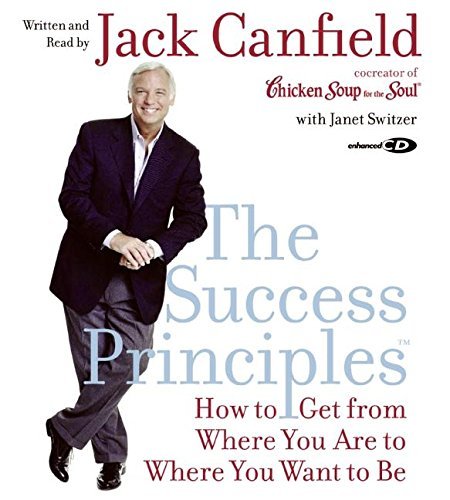
The Success Principles
ISBN : 9780007195084
Author : Jack Canfield
(0 Reviews)
In stock
Estimate Shipping Time:
Sold By:
Inhouse product
Inhouse product
Price:
EGP670.000
Share:
Vista Ecommerce
(0 customer reviews)
Top Selling Products
-

As Long As the Lemon Trees Grow
EGP385.000 -
Pinocchio (Campbell First Stories)
EGP290.000 -
The Ritual
EGP480.000 -
Before the Coffee Gets Cold
EGP480.000 -
The Psalm Killer
EGP480.000 -
هوامش المقريزي حكايات من مصر
EGP180.000




Let me start by saying I'm a fan of the self-help genre: what could be more noble than trying to help others help themselves? Writers like Dale Carnegie and Norman Vincent Peale are my idols. For this reason, I should have been predisposed to enjoy Jack Canfield's _The Success Principles_, right? Well, the expectation turned out to be unfounded: I consider this heavy tome a failure.There is a saying in my native language that goes like this: "Self-praise stinks." Oh my, if that saying is true... then this book stinks all the way to heaven! The book is extremely long (artificially so), but on what seems like every second page, Jack Canfield congratulates himself on his monumental worldly achievements, his fabulous career, his immense wealth, and so on.The self-praise, overblown out of all proportion, is not limited to Jack Canfield himself. Here is how the book's co-author, Janet Switzer, is described in the "About the Authors" section:<< Today, she's the marketing genius and business growth expert of choice for some of the world's top success gurus [...]. Additionally, Janet has counseled more than 50,000 companies and entrepreneurs worldwide in leveraging their intangibles and information assets for untold millions in potential windfall revenue. [...] She regularly speaks to thousands of entrepreneurs, independent sales professionals, corporate employees, and industry association members on the principles of success and income generation. Additionally, she helps achievers who are experts in their field attain worldwide status and million-dollar incomes by building publishing empires around their business strategies, training concepts, industry expertise, and unique market posture. >>Erm, exaggerate much? Are we reading a book here, a work of literature, or some advertisement, a promotional leaflet perhaps? And it's not just the "About the Authors" section that makes you feel as if you were reading an advertisement produced by a corporate PR/marketing department -- you can't quite get rid of the feeling *throughout* the book. You get the idea: it's all about the many dozens, hundreds, thousands, and yes, "untold millions". Reading a passage like the above may be good for a laugh if you just read it *once or twice* -- but if the book contains very similar statements on practically every page, this gets tiresome soon.It's not just the ceaseless self-praise that is repulsive about the book. The focus the book places on materialism is astounding. I agree that this is only the superficial impression, and that Jack Canfield does imply there are other values in life as well. However, those subtler undertones get completely drowned out in the odes Canfield tirelessly sings on material riches throughout the book. And here is the quote by Wallace D. Wattles, chosen by Canfield to introduce Chapter 60, that nicely sums up what's wrong about the overall tone of _The Success Principles_:<< Whatever may be said in praise of poverty, the fact remains that it is not possible to live a really complete or successful life unless one is rich. >>Oh, really? Well, it's definitely Mr. Wattles's and Mr. Canfield's prerogative to believe this -- but to those readers who believe otherwise, reading this book will be a struggle. By the way, I wonder what a certain figure named Jesus Christ would have thought of the above statement -- one only needs to recall his (mistranslated) "camel and eye of the needle" metaphor (Mt 19:24). Here is another sample:<< Multimillionaire Dr. John Demartini is a resounding success by anyone's standards. He's married to a beautiful and brilliant woman -- Athena Starwoman, the world-famous astrologer who consults and writes for 24 well-known magazines, including Vogue. Together, they own several homes in Australia. And they spend over 60 days a year together circumnavigating the globe in their $3 million luxury apartment onboard the $550 million ocean liner World of ResidenSea -- a residence they purchased after selling their Trump Tower apartment in New York City. >> (chapter 15)If that doesn't elicit a guffaw from you, I don't know what will. In fact, there are so many silly passages in the book resembling the one just quoted, that you sometimes feel the book should perhaps be sold with a warning label or sticker on it, "Do not open if your IQ is in three digits".The "Acknowledgments" section of _The Success Principles_ implies that a great many people were involved in the production of the book: proofreading it, suggesting improvements, and so on. In light of this, it is surprising how the book appears to be so weak structurally. A clear, systematic, internal organization of ideas seems to be missing, despite the 6 sections and 64 chapters -- reading the book felt more like, "anything goes", and "let's throw this in as well". The book definitely seems overlong; you feel as if much of it could be cut; the text sometimes gives you the impression of just being an unending series of anecdotes, with a few homespun pearls of wisdom thrown in here and there. The book lacks depth, and seems comfortable with sliding on the surface most of the time.The authors' intention apparently was to write in an as easy-to-understand way as possible -- in this, they definitely succeeded. However, there are two ways of writing simply (which is a commendable goal): discussing complex matters in an easy-to-understand way, without neglecting any complexities underneath; or just write in an easy-to-understand way, *ignoring* the complexities underneath. Unfortunately, _The Success Principles_ falls into the second category.It is surprising to see so many 5-star reviews of the book here on Amazon. It's not just surprising, but suspicious. Most of the 5-star reviews seem confined to a few brief, general sentences of praise that *anyone* could have said even *without* reading the book; there seems to be no *personally felt* connection between the reviewer and how the book affected him/her. You also get a weird feeling while reading the many endorsements of _The Success Principles_ printed right inside the book. Again, the personal connection between the book and the quoted person, praising the book so effusively, seems to be absent. You get the impression as if the endorsements originated more in the way of, "Hey, buddy, can you please endorse my new book? I'll make sure to endorse yours the next time around."Why, then, 2 stars for _The Success Principles_, instead of just 1? Because reading it is not a complete waste of time. The book does contain important insights, many good anecdotes, and lots of impressive quotes. The quotations are more impressive, in fact, than the main text of the book. Here is a sample of a nice anecdote, from chapter 16:<< Legendary violinist Isaac Stern was once confronted by a middle-aged woman after a concert. She gushed, "Oh, I'd give my life to play like you!" "Lady," said Stern acidly, "that I did!" >>And here are a couple of impressive passages written by Canfield himself:<< When you perform any task in real life, researchers have found, your brain uses the same identical processes it would use if you were only vividly visualizing that activity. In other words, your brain sees no difference whatsoever between visualizing something and actually doing it. >> (chapter 11)<< I've had people in my seminars who, when they finally *truly* forgive someone, release long-term migraine headaches within minutes, find immediate relief from chronic constipation and colitis, release their arthritis pain, improve their eyesight, and immediately experience a host of other physical benefits. One man actually lost 6 pounds in the following 2 days without changing his eating habits! I have also seen people subsequently create miracles in their careers and financial lives. Believe me, it is definitely worth the effort. >> (chapter 29)The thing I liked most about _The Success Principles_ were the many delightful quotations interspersed throughout the text. Here are a few of them to give you a foretaste:<< If you can't, you must, and if you must, you can. >> (Anthony Robbins, in chapter 15)<< You are the average of the five people you spend the most time with. >> (Jim Rohn, in chapter 25)<< You are a living magnet. What you attract into your life is in harmony with your dominant thoughts. >> (Brian Tracy, in chapter 26)<< You must begin to understand, therefore, that the present state of your bank account, your sales, your health, your social life, your position at work, etc., is nothing more than the physical manifestation of your previous thinking. If you sincerely wish to change or improve your results in the physical world, you must change your thoughts, and you must change them IMMEDIATELY. >> (Bob Proctor, in chapter 56)<< Too many people spend money they haven't earned, to buy things they don't want, to impress people they don't like. >> (Will Rogers, motto of chapter 59)<< It is one of the beautiful compensations of this life that no man can sincerely try to help another without helping himself. >> (Ralph Waldo Emerson, motto of chapter 62)
There have been no reviews for this product yet.
Related products

EGP900.000
The Changing World Order

EGP665.000
Winning Her Business

EGP700.000
Winning Her Business

EGP630.000
Social Media Success for Every Brand
EGP665.000
The Code of Trust

EGP1,050.000
You Can't Know It All
EGP980.000
Entrepreneurial Leadership

EGP760.000
First-Time Parent

EGP395.000
Start Now, Get Perfect Later

We are offering a great experience and connecting readers with a variety of original unique collection of books.
Contact Info
- Address: Arkan Plaza, Zayed, 6th of October, Egypt
- Phone: +201221729092
- Email: Support@readerscorner.co